
AnthC datasheet
AnthC, Anthilla Controller
The Anthilla Controller Board for IoT Projects
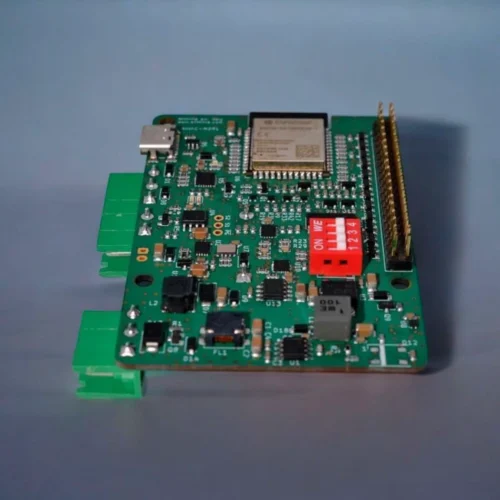
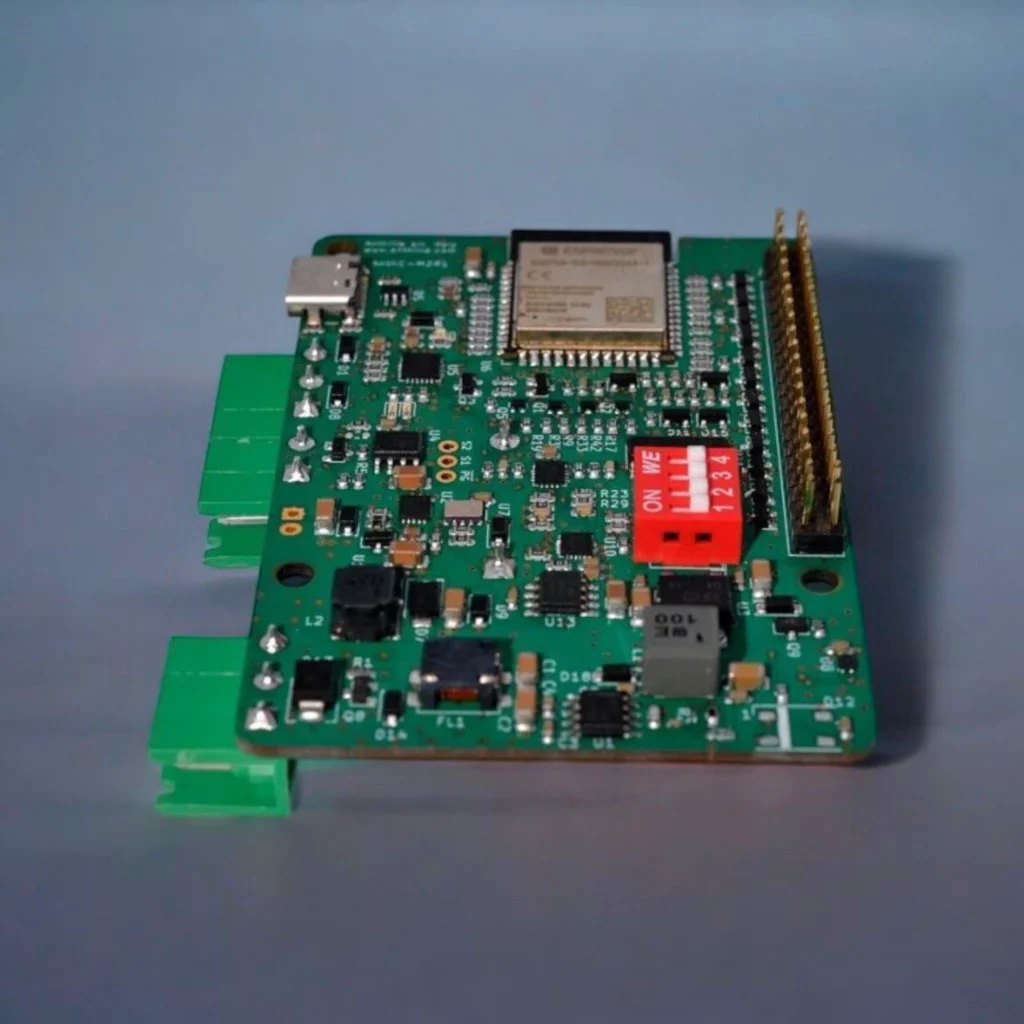
The Anthilla Controller Board (AnthC) is a versatile logic control board, designed to simplify the integration and management of IoT (Internet of Things) projects. Thanks to its flexibility and modularity, it is an excellent choice for applications in various sectors, from industrial control to home automation.
The board has a format similar to the Raspberry Pi, which facilitates integration with mechanical and electrical components already available on the market. However, it is important to note that the pin configuration of the AnthC is not identical to that of a Raspberry Pi, therefore it is recommended to consult the manual before installing external components.
Why a new board?
Having tackled, as Anthilla, various automation projects that deviated from the OT (Operational Technology) world, i.e. classical automation, moving more toward the Smart things or IoT world,
also in the context of Industry 4.0 and IIoT,
we found that all the projects tackled, and especially those that require a customized component to create real Value expressed as “Competitive Advantage” for the company that needs to make its product “smart”.
There were therefore a whole series of similar aspects that could be solved and accelerated by separating all those functions that coordinate at a high level “how the product should behave” and that in fact coordinate and manage all or part of the internal functions, simplifying programming but also making it “unique” through the company’s know-how.
This was done in order to have an approach closer to information technology (IT, Information Technology) and the Arduino/Maker world, compared to a more classical approach to automation (OT, Operational Technology), trying to amplify ease of adoption, freedom of use, solidity and resilience, reducing the implementation costs of a wide range of projects.
The Role of the Anthilla Controller (AnthC)
The board is not a power controller, but a board for logic control and coordination of other boards and devices.
It is developed to be extremely solid, resistant, reliable, resilient and redundant, starting from multiple power supply, up to working in cluster with other boards both of the same type and of different types.
It was born to accompany or replace the use of PLCs and other types of controllers in different types of projects and accelerate the digitalization and automation of processes, bringing OT (Operational Technology, meaning classical automation) more and more toward the world of IoT, and IIoT and therefore Industry 4.0 and 5.0, accelerating and simplifying the digital transition in a solid way.
Main features
The AnthC board offers a series of features that make it a powerful and flexible solution for IoT projects:
- ESP32-S3 microcontroller: the heart of the board, with Bluetooth Low Energy and Wi-Fi 2.4 GHz (b/g/n) communication capabilities.
- Flexible power supply: can be powered with a voltage from 7V to 28V, with the possibility of powering only the low-voltage area.
- Inputs and outputs: 4 digital inputs, 4 analog inputs (16-bit ADC) or switchable 4-20mA inputs, 6 open collector outputs.
- Communications: RS485, I2C, SPI interfaces for communications in industrial environments or with other modules and sensors.
- Real-time clock (RTC) with coin cell backup battery for time continuity.
- USB-C port for power supply and communications.
- RGB LED, rechargeable LiPo battery and extended temperature range.
Block diagram (rev. M2-R5)
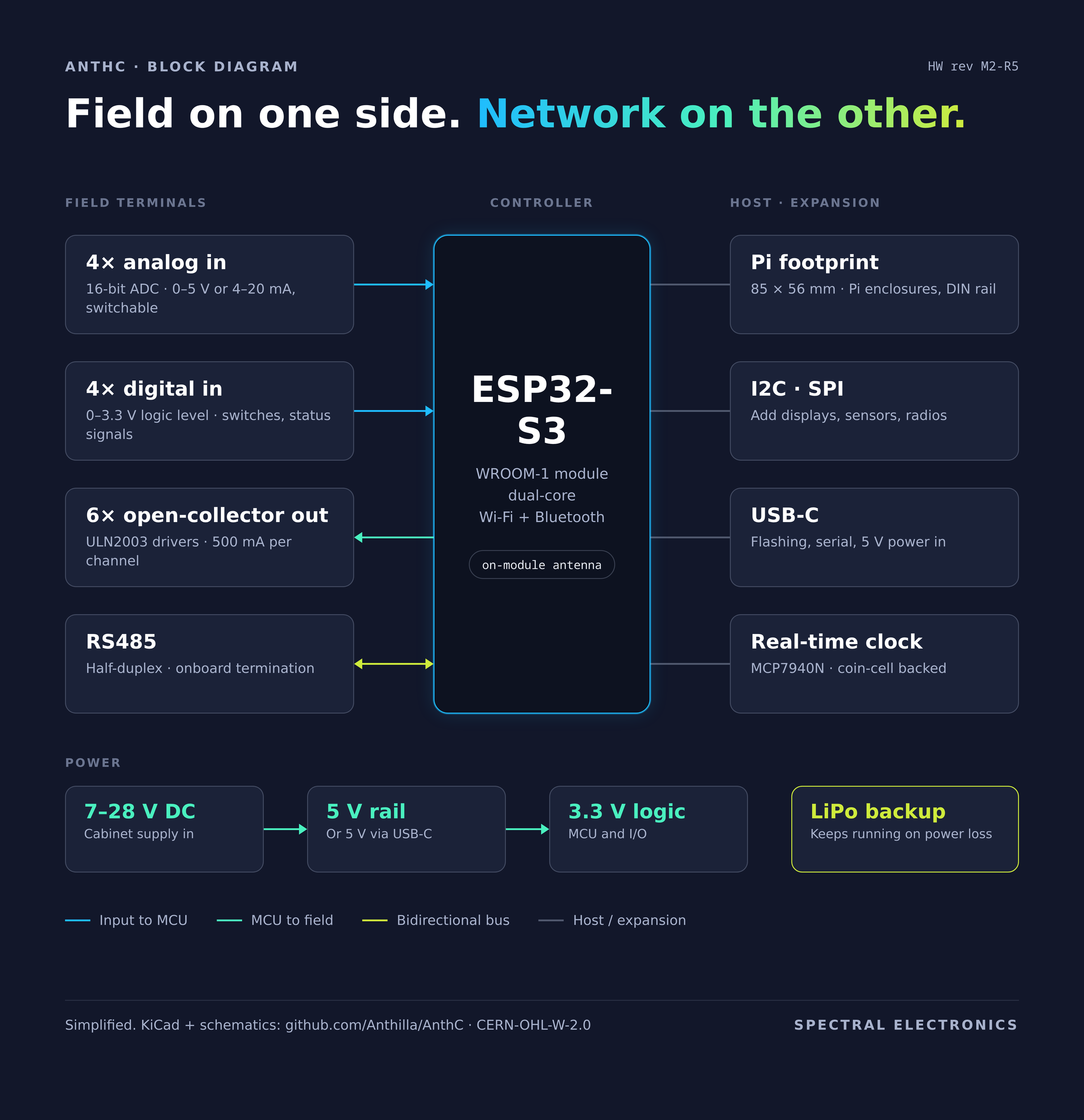
AnthC block diagram rev. M2-R5 — Spectral Electronics. Tap to open the full-screen version.
Project history
The AnthC project began in 2019, when the Italian IT services company Anthilla started to condense into a single project all the features requested by clients and prospects for POC (Proof Of Concept) projects ranging from elevator automation, distributed sensor management, telemetry data acquisition, home automation, beacon tower management and automation and sensorization of industrial parking lots and difficult environments.
The electronic designer Esteban Corredor, who supported Ivan Dorna of Anthilla in the design and realization of the first version of the board.
Once the concept was demonstrated, we tried to involve other contributors to bring the product to market.
Ignacio de Mendizábal expert electronic designer specialized in managing electromagnetic emission specifications (EMC) continued the work and worked on version M2-R2, M2-R3 and M2-R4, which are the ones on which the current technical specifications are based.
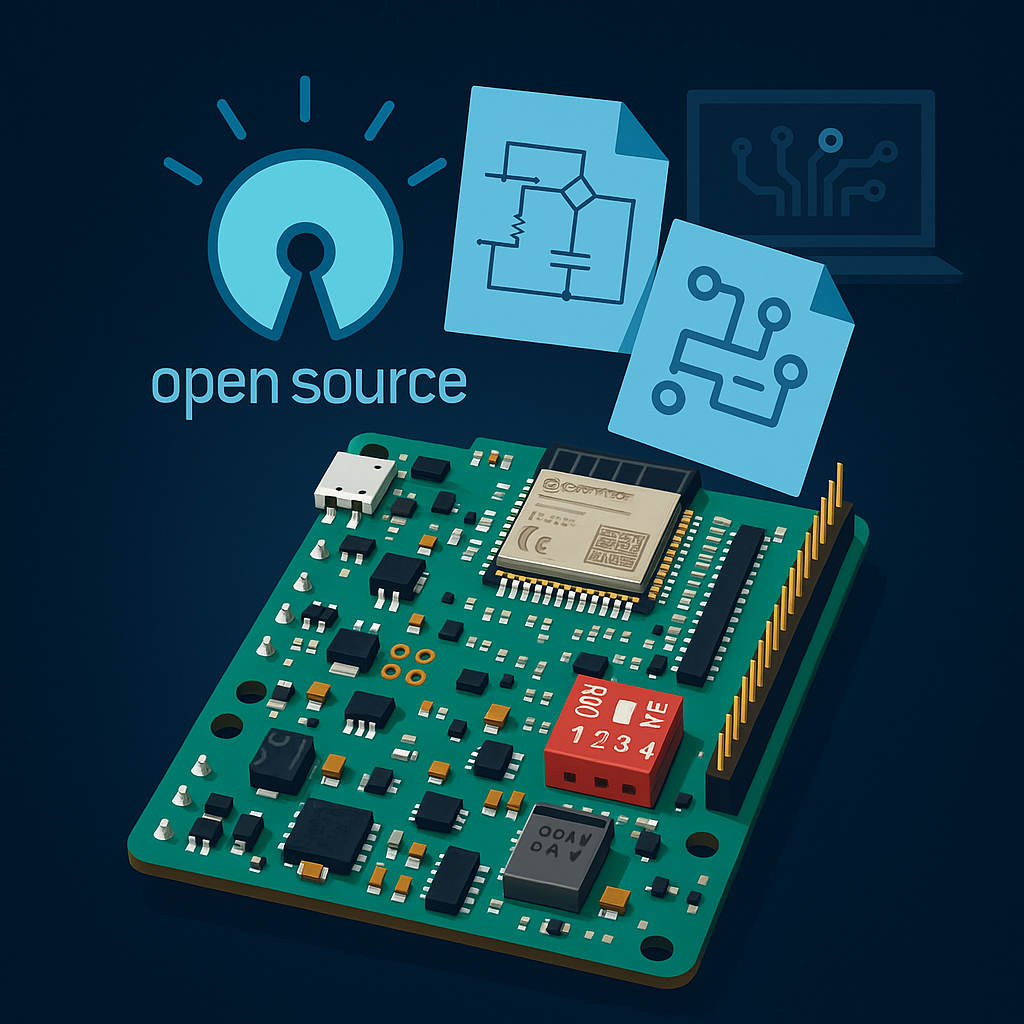
The entire project is open source: the design, production and assembly files are publicly available on the project repository.
This openness reflects the team’s philosophy, which wanted to make the project accessible, collaborative and transparent.
Hardware Partner
CEO & Founder — Spectral Electronics
Electronic designer specialized in electromagnetic compatibility (EMC) and product certification for the aerospace, IoT, industrial and medical sectors. Maintainer and business partner of Anthilla on the AnthC project: coordinates hardware evolution, CE certification and industrialization. He continued the work on versions M2-R2, M2-R3 and M2-R4. Selected among the 50 Hardware Innovators 2026 by AllSpice.io.
Spectral Electronics — Avenida Novo Mesoiro 2, Bajo, 15190 La Coruña, Spain
Open Source: Why this choice?
Open-source hardware projects often raise doubts, mainly related to intellectual property protection or the fear of losing a competitive advantage. However, examples like Arduino, Raspberry Pi and openBCI demonstrate that open-source hardware development can be successful, offering numerous advantages:
- Transparency and trust: users can examine the project files, such as the electronic schematic or PCB production files, to understand how the system works.
- Education: the project can be used as a learning tool for those who want to deepen their knowledge of IoT and electronics.
- Long-term support: even without the original authors, new contributors can carry the project forward, ensuring continuous maintenance.
- Repairability: users can repair and maintain systems autonomously.
In line with these principles, the AnthC has obtained the Open Source Hardware certification, which confirms the project’s compliance with community standards.
Version M2-R3 received UID IT000013, while version M2-R4 obtained UID IT000014.
The difficulties encountered
Like many other projects, the AnthC also suffered delays due to supply chain disruptions during the Covid 19 pandemic. This forced the team to replace several components and repeat verification tests, delaying the production of the new version.
Next Steps
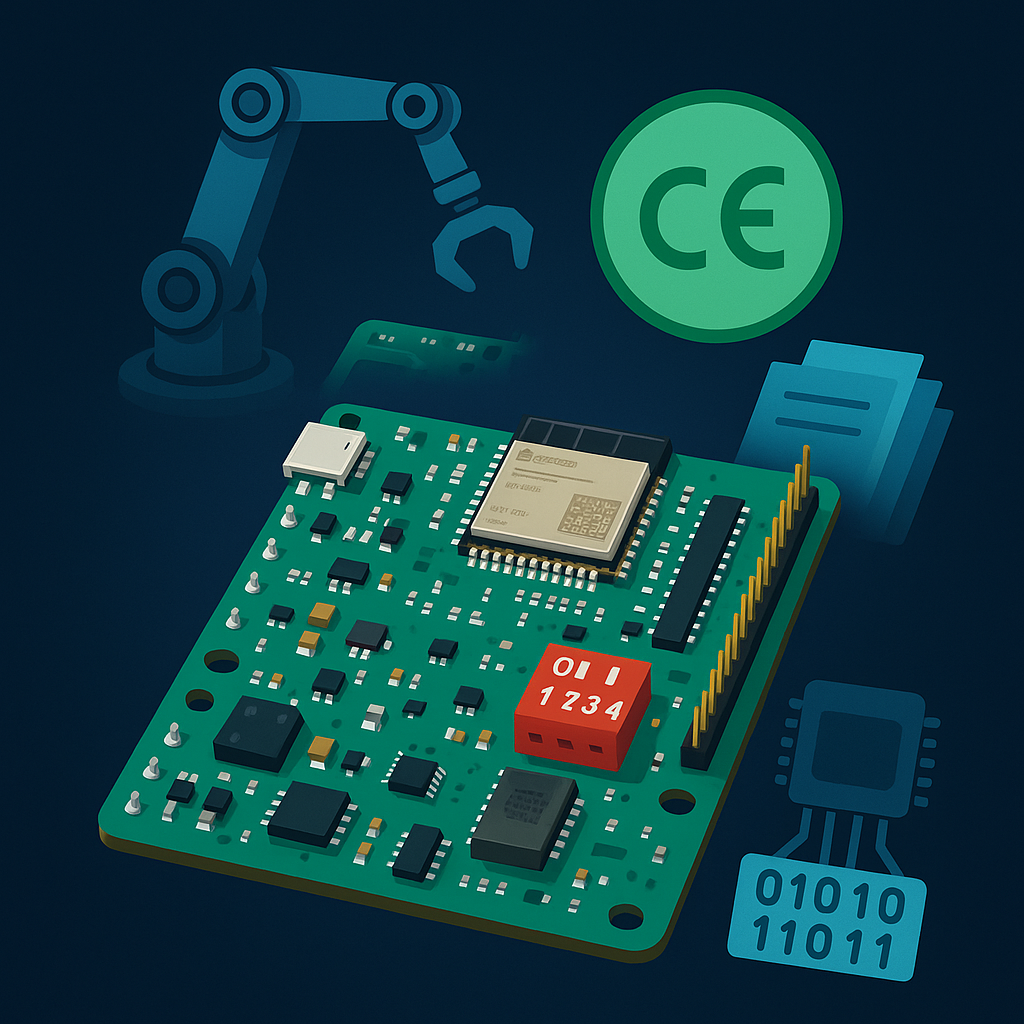
The current revision is M2-R5 (USB-C connector fix and ULN2004 driver replaced by ULN2003): it is on sale at Elecrow and fabrication/assembly files are published in the GitHub releases. M2-R3 and M2-R4 are OSHWA certified (IT000013, IT000014); M2-R5 certification is pending. CE/EMC marking remains the responsibility of the end-product integrator.
- OSHWA certification of revision M2-R5 (M2-R3 and M2-R4 already certified).
- Writing documentation for end users.
- Development of a base firmware.
Instead:
- Electromagnetic compatibility (EMC) testing.
- Obtaining CE certification for sale in the European market.
- Are currently delegated to whoever needs to implement the board in a project.
The Anthilla Controller Board represents an excellent example of an open-source project, born from collaboration between experts with a clear technical and commercial vision.
Its advanced technical features, combined with the open-source approach, make it an ideal platform for those who want to develop complex IoT projects. Thanks to the transparency and accessibility of the project, AnthC not only supports innovation and collaboration, but also offers a powerful educational tool for engineers and developers.
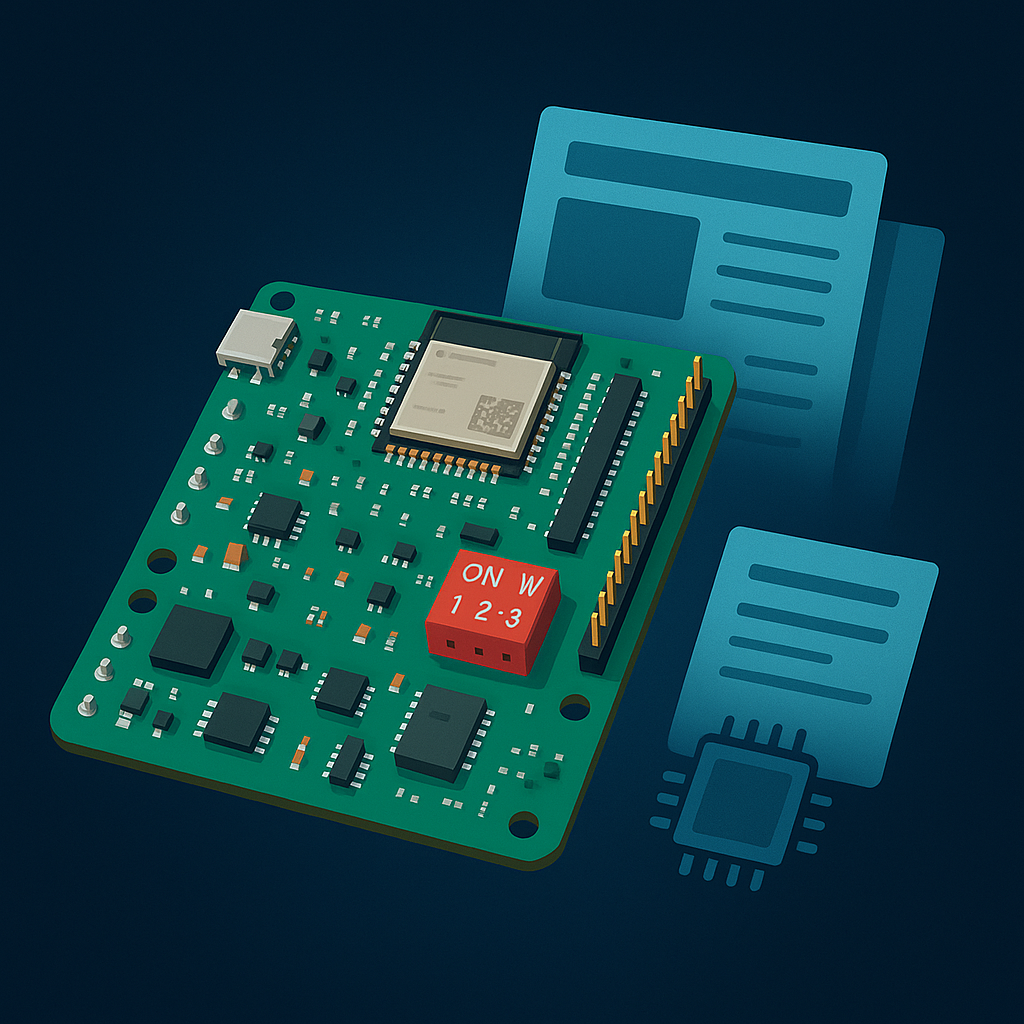
The board has been mentioned in the following articles:
- Building and Certifying an Open-Source IoT Controller, Part 1
- Building and Certifying an Open-Source IoT Controller, Part 2: Open-Source Certification
- Building and Certifying an Open-Source IoT Controller, Part 3: Manufacturing and Testing
- Building and Certifying an Open-Source IoT Controller, Part 4: Regulatory Compliance
- https://hackaday.io/project/194974/gallery
- M1R1 on youtube: https://www.youtube.com/watch?v=3HQPAL7ewI0
