
Approach and method
Approach and method
The how makes the difference: from the scientific method applied to projects, to a methodology that teaches AI not to make mistakes.
Every architecture is made of choices, and every choice has a hidden cost: the time and energy spent deciding.
Our method stems from a simple observation: in projects, what blocks is almost never the technique. It is unmanaged indecision. From this observation, in 2022, an internal classification was born that today is the heart of everything we do: with people, with systems and with artificial intelligences.
The roots: problem analysis and division, and experimental scientific method applied to everything

Measure first, declare later
No result is declared without empirical verification: a hypothesis is formulated, tested in the real context, measured and only then asserted. This applies to an infrastructure, a business process and the response of an AI model. What is not measured is not done: it is only declared.

Applied logic, not opinions
The best decisions come from the real context, not from preconceptions. This is why every analysis starts with the complete enumeration of what exists: resources, constraints, dependencies, alternatives. First you observe, then you classify, then you decide. The order is not reversible.

Error is data, not blame
Every error is cataloged, analyzed at the root and transformed into a rule that prevents repeating it. This is the principle of continuous improvement: the system we use today is the documented sum of all the errors we no longer repeat.
RSI: the classification that unblocks decisions
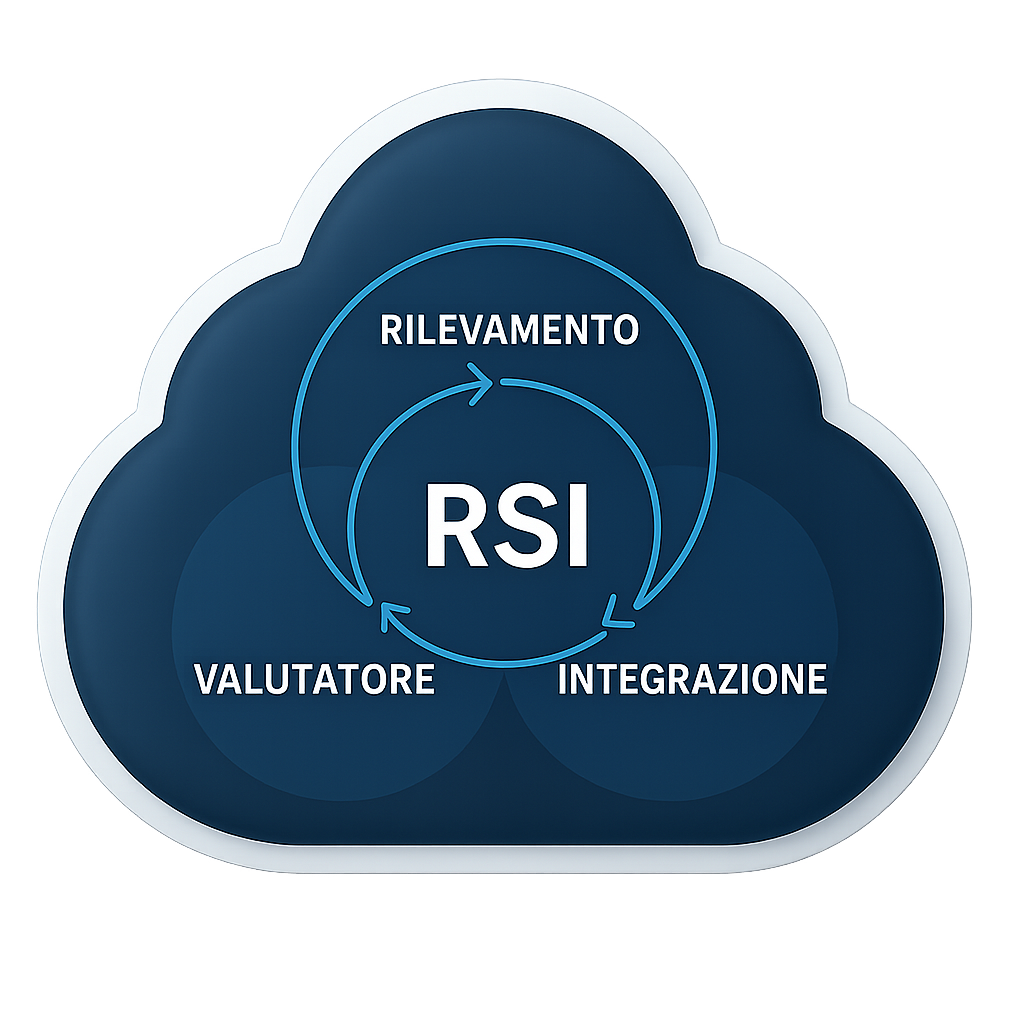
Recognition of Indecision Situations (2022)
RSI is our first internal classification, born to manage and catalog everything that blocks and lengthens the decisional component in project management: deferred choices, implicit responsibilities, context ambiguities, never-closed options. Giving a name to each type of block is the first step to untangling it.

Managed indecision is an asset
Not all indecisions should be eliminated: some should be kept open explicitly and consciously, until the context matures. RSI distinguishes strategic indecision, which protects future options, from suffered indecision, which consumes time and trust. Every choice made or deferred carries a responsibility that must be managed explicitly.

Two separate cognitive modes
Planning and executing are different mental states and RSI keeps them separate: in planning you explore, map options and manage uncertainty explicitly; in execution you act traceably, without reopening what has already been decided. Mixing the two modes is the first cause of projects that never finish.
From projects to AI: labeling hallucinations

The same classification, a new subject
Since 2022 we have applied RSI to a new subject: artificial intelligence models. By systematically labeling the hallucinations of various models, we discovered that AI errors follow catalogable patterns, just like human decisional blocks: context loss, false certainty, premature closures, coherence that degrades over time.

The mnemonic-cognitive Prompt Framework
From that cataloging our mnemonic-cognitive Prompt Framework was born: a multi-level structure that gives the model persistent memory, empirical verification rules and honesty protocols about its own limits. The measured result: reduction of hallucinations and errors up to over 90%, with repeatable coherence checks (our cognitive Fencing Tests).
Works on many models, including local ones
The framework does not depend on a vendor: it is applicable to many AI models and assistants, including local models run on own infrastructure. This means bringing AI quality and reliability even where data cannot leave the company perimeter. In 2026 the framework reached version 9.2.
Teaching AI focus and coherence over the long term

From management method to teaching methodology
The natural evolution: what was born to organize and manage projects has become a methodology to teach AI how to maintain focus and coherence in long sessions, where models tend to degrade. Structured memory, context anchoring, verification before declaration: the same disciplines that make a team reliable make a model reliable.

Honesty before plausibility
A well-instructed AI must be able to say “I don’t know” and “I haven’t verified this”. The framework requires that every factual statement be supported by evidence gathered in the context, and that limits be declared rather than masked by plausible answers. It is the difference between an assistant that seems good and one you can trust.
The RSI cycle

Analyzer
Explores the real context: collects signals, identifies patterns and indecision situations to untangle.

Evaluator
Weighs options and verifies coherence: transforms doubts into measurable choice criteria.

Executor
Puts the decision into practice: acts in a modular, autonomous and traceable way.

Feedback
Closes the cycle and reopens it: measures the result and feeds the continuous adaptation of the system.
Continuous improvement, actually applied

The system that improves the system
Continuous improvement is not a slogan: it is an operational cycle that we apply first of all to ourselves. Our systems measure themselves, signal their own anomalies, document every intervention and transform every incident into a permanent rule. The same discipline we propose to clients governs our infrastructure every day.

Resource usage: measured efficiency
Every resource, of computation, time or attention, is used where it produces measurable value. We automate what is repetitive, preserve human intervention where judgment is needed, and periodically review allocation based on collected data. Efficiency is not cutting: it is not wasting.

What does not evolve, extinguishes
Un sistema funziona solo se sa adattarsi. Per questo ogni progetto che consegniamo include il modo in cui evolverà: chi lo misura, come si corregge, dove si documenta. La manutenzione non è un costo accessorio: è la forma concreta della continuità.
Let’s talk about your project: the method adapts to the context, not the other way around.
