
AnthC
AnthC: Anthilla Controller Board

What is AnthC
The Anthilla Controller Board (AnthC) is an open source control board designed to simplify the integration and management of IoT (Internet of Things) projects. Thanks to its flexibility and modularity, it is a solid choice for applications in various sectors, from industrial control to home automation.
The board adopts a form factor compatible with the Raspberry Pi, which facilitates integration with mechanical and electrical components already available on the market. However, the pinout is not identical to that of a Raspberry Pi: before connecting external components, it is recommended to consult the documentation.
Technical specifications
Main specifications
AnthC provides a set of interfaces and inputs/outputs designed for the industrial and automation world:
- Microcontroller: ESP32-S3-WROOM-1, dual-core with Wi-Fi (802.11 b/g/n), Bluetooth and on-board antenna.
- Digital inputs: 4 digital inputs.
- Outputs: 6 open collector outputs (ULN2003 drivers, 500 mA per channel).
- Analog inputs: 4 analog inputs with 16-bit ADC, switchable 0–5 V or 4–20 mA (multiplexed).
- Communication: half-duplex RS485 (SP3485EN, on-board termination), I2C, SPI and USB-C port (programming and 5 V power).
- Real-time clock MCP7940N with CR2032 backup coin cell.
Power supply and autonomy
The power supply is designed with an extended range from 7V to 28V input; the board can also operate powered at just 5V via the USB-C port. Support for a rechargeable LiPo battery with on-board charger is present, useful for providing operational continuity and managing power interruptions.
Block diagram
The following diagram — provided by Spectral Electronics — summarizes inputs, outputs, buses and the power domain of the board in revision M2-R5:
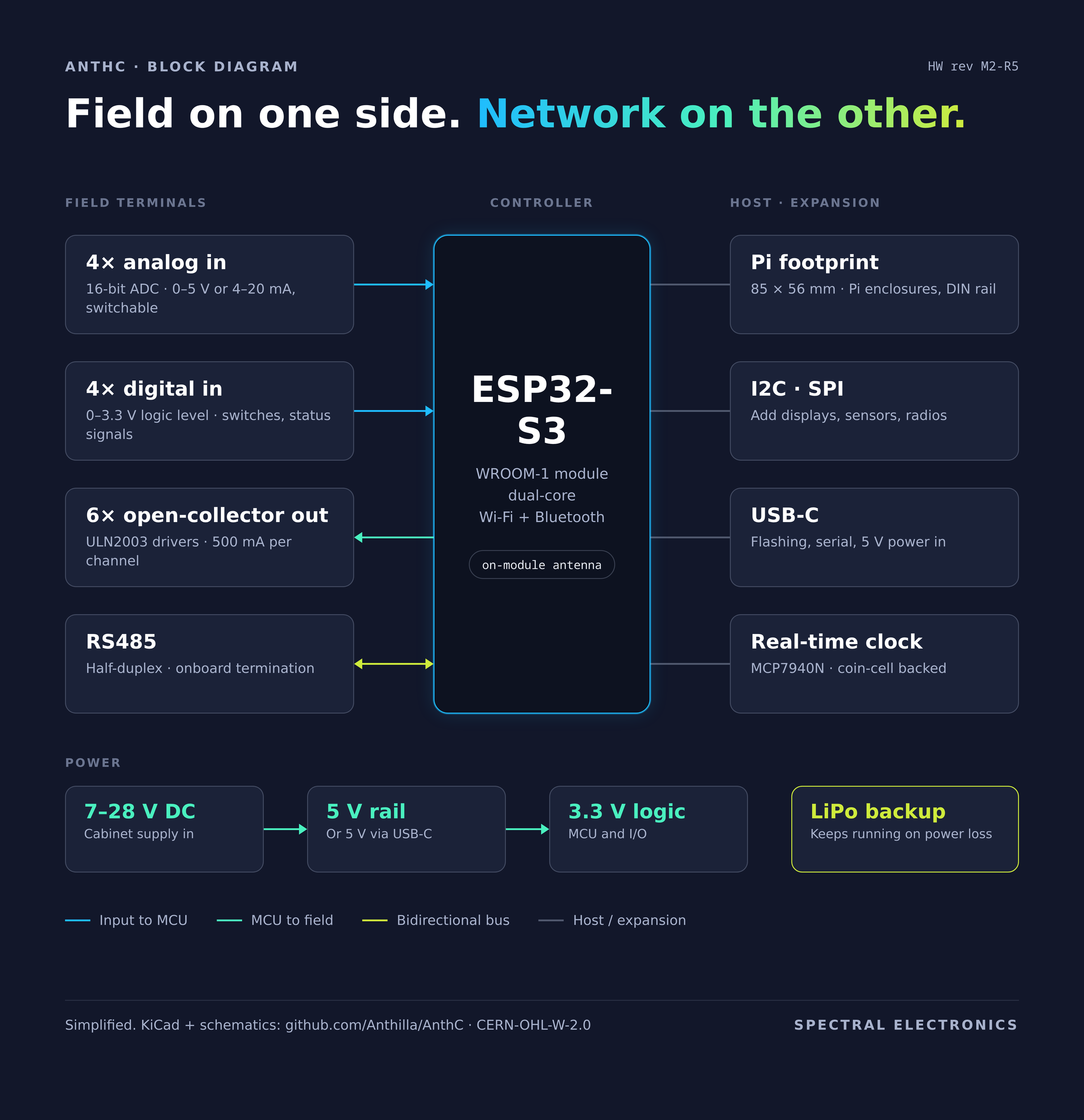
AnthC block diagram rev. M2-R5 — Spectral Electronics. Tap to open the full-screen version.
Gallery
Project history
From 2021 to today
The AnthC project was born in 2021: the requirements were defined jointly by Anthilla, an Italian IT services company (with Ivan Dorna), and electronic designer Esteban Corredor, who supported Anthilla in the design and realization of the first version of the board. Once the concept was demonstrated, the work continued toward a market-ready version.
The current maintainer and business partner of the AnthC project is Ignacio de Mendizabal. Founder of Spectral Electronics, he is independent in technical development but operates as a business partner of Anthilla on the AnthC project: he coordinates hardware evolution, certification and industrialization. An electronic designer specialized in electromagnetic compatibility (EMC), he continued the work on versions M2-R2, M2-R3 and M2-R4, on which the current technical specifications are based. He works on electromagnetic compatibility and certification of products for the aerospace, IoT, industrial and medical sectors, and was selected among the 50 Hardware Innovators 2026 by AllSpice.io.
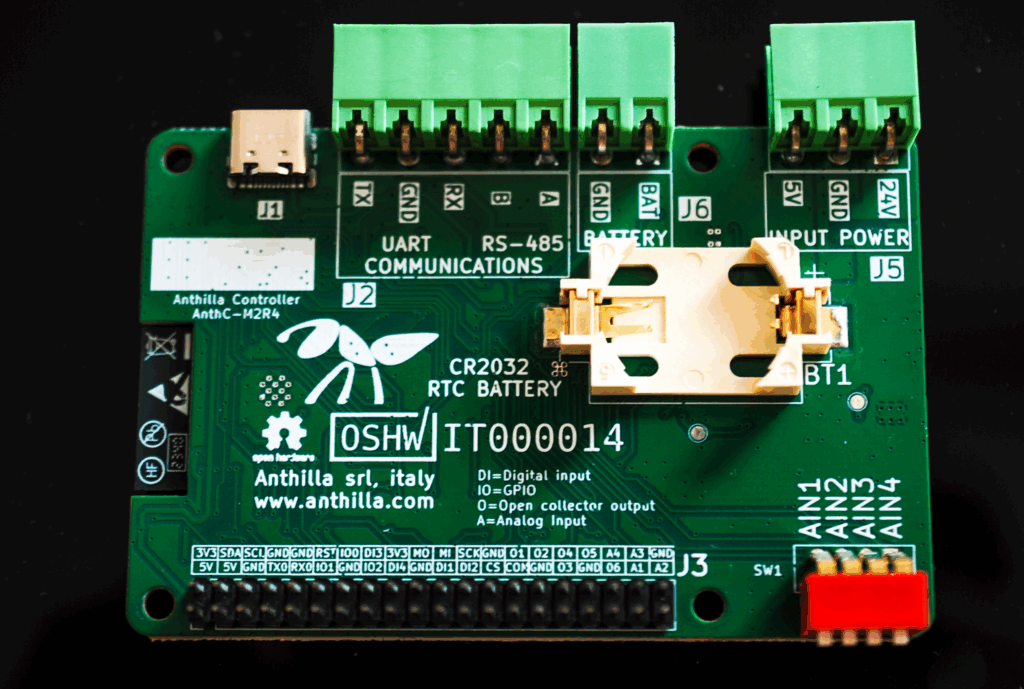
The current revision is M2-R5, an evolution of the M2-R4 batch whose real photos are visible in the gallery above.
Hardware Partner
CEO & Founder — Spectral Electronics
Electronic designer specialized in electromagnetic compatibility (EMC) and product certification for the aerospace, IoT, industrial and medical sectors. Maintainer and business partner of Anthilla on the AnthC project: coordinates hardware evolution, CE certification and industrialization. He continued the work on versions M2-R2, M2-R3 and M2-R4. Selected among the 50 Hardware Innovators 2026 by AllSpice.io.
Spectral Electronics — Avenida Novo Mesoiro 2, Bajo, 15190 La Coruña, Spain
Project status
The current revision is M2-R5 (USB-C connector fix and ULN2004 driver replaced by ULN2003): fabrication and assembly files are published in the GitHub releases and the board is on sale at Elecrow. Revisions M2-R3 and M2-R4 are OSHWA certified (UIDs IT000013 and IT000014); M2-R5 certification is pending. It is not CE/EMC certified: conformity assessment of the end product remains the integrator’s responsibility.
Released
M2-R5 revision
Production files on GitHub, on sale at Elecrow
In progress
OSHWA certification M2-R5
M2-R3 and M2-R4 already certified (IT000013, IT000014)
Planned
CE / EMC Certification
Electromagnetic compatibility testing and CE marking
Planned
Documentation & firmware
User manual, examples and base firmware for ESP32-S3
Milestones and timeline
The main hardware revisions and project milestones, from the first version to the current release:
2021 — Project start. Requirements definition with Anthilla (Ivan Dorna) and Esteban Corredor. First conceptual version and principle demonstration.
M2-R2 — Second hardware revision. Layout and component refinement after initial testing.
M2-R3 — Third revision. Power supply and interface optimization. Start of collaboration with Ignacio de Mendizabal (EMC Specialist).
M2-R4 — OSHWA certified with UID IT000014. Signal+Power / GND / GND / Signal+Power stackup; battery control: BJT replaced by MOSFET.
M2-R5 (current) — Current release: USB-C connector fix and ULN2004 driver replaced by ULN2003. On sale at Elecrow; OSHWA certification pending.
Next — EMC testing and CE marking (responsibility of the end-product integrator), user documentation, base firmware and examples.
Next steps
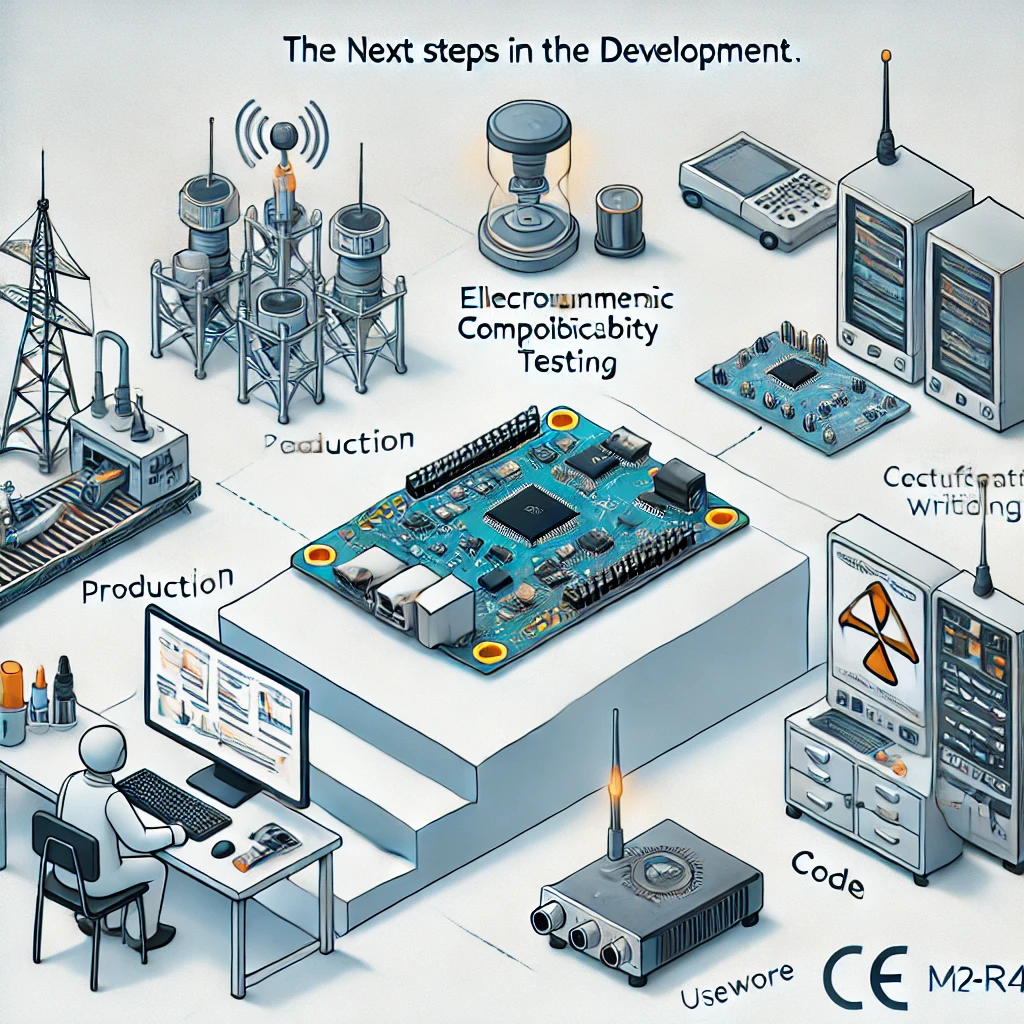
Revisions M2-R3 and M2-R4 are OSHWA certified (IT000013 and IT000014); M2-R5 certification is pending, while EMC testing and CE marking have not been performed yet. The planned next steps:
- OSHWA certification of revision M2-R5 — application pending after IT000013 and IT000014.
- Electromagnetic compatibility (EMC) testing — preparation for CE marking.
- CE certification for sale in the European market.
- End-user documentation — manuals, schematics, integration guides.
- Base firmware — open source firmware development for ESP32.
- Transition to industrial production — from small batches to serial production.
Note: EMC testing and CE certification are currently delegated to whoever implements the board in a specific project, as they depend on the final integrated system.
Open source

Licenses and philosophy
AnthC is an open source hardware project: the design, production and assembly files are public. The hardware is released under the CERN-OHL-W-2.0 license (CERN Open Hardware Licence, Weakly Reciprocal variant), while the documentation is released under Creative Commons CC0-1.0. The project is marked as Open Source Hardware (OSHW).
The openness reflects the team’s philosophy: transparency, repairability, educational value and the possibility for new contributors to carry the project forward over time. The source code and project files are published on the official Anthilla/AnthC GitHub repository. The project requires KiCad 10 or later; the user manual and fabrication/assembly files (Gerbers, BOM, STEP, schematic PDFs) are published per revision in the repository releases. For project information: projects@anthilla.com.
In-depth articles and certification
The open source design, production, testing and certification journey of AnthC is told in a series of articles published on All About Circuits, plus the project page on Hackaday.io:
